The CE4CE (Circular Economy for Public Transport) Interreg Central Europe project officially came to an end on 30 April 2026 after three years of collaboration among public transport operators, cities, experts, and other stakeholders across Central Europe. The project focused on accelerating the transition towards a more circular, resource-efficient, resilient, and low-emission public transport sector. Rather than focusing only on reducing emissions, CE4CE looked at the entire life cycle of public transport assets, including energy, infrastructure, vehicles, batteries, buildings, procurement, and governance.
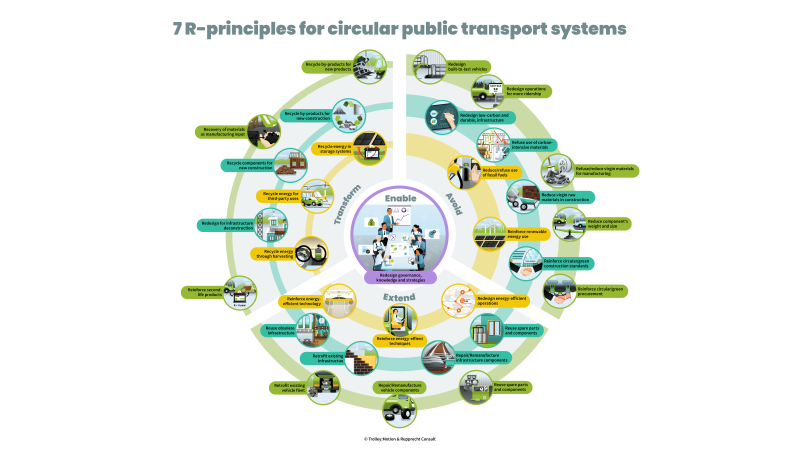
Another important result was the Public Transport Circularity Compass, a practical assessment tool designed to help public transport authorities and operators assess the circularity of their systems and where improvements can be made. The Compass supports the evaluation of vehicles, infrastructure, energy, and governance from a whole-life-cycle perspective. It allows organisations to identify opportunities to use resources more efficiently, extend the lifetime of assets, reduce waste and emissions, and move towards more circular transport systems.
The CE4CE Knowledge Hub is a platform where this tool is available along with other information regarding circularity. Furthermore, an online Matchmaking Forum was created where public transport operators and suppliers can exchange information and identify opportunities to reuse components and develop circular products.
Public Transport Circularity Compass
Copyright: Trolley:motion & Rupprecht Consult
A projekt egyik központi eredménye a körforgásos gazdaságra vonatkozó stratégiák és akciótervek kidolgozása volt. A stratégiák három fő területre összpontosítottak: az energiára, az infrastruktúrára és a járműállományra. A kidolgozásukat a Körforgásos iránytű és az AETE keretrendszer – Avoid, Extend, Transform and Enable, vagyis Elkerülés, Élettartam-hosszabbítás, Átalakítás és Lehetővé tétel – támogatta. A keretrendszer strukturált módon segít azonosítani az erőforrás-felhasználás, a hulladék és a környezeti hatások csökkentésének lehetőségeit a közösségi közlekedési rendszerek teljes életciklusa során.
A stratégiák alapján négy, a helyi igényekhez igazított akcióterv készült Maribor, Lipcse, Gdynia és Bergamo számára. A tervek olyan gyakorlati kérdésekkel foglalkoztak, mint a keletkező energia visszanyerése és hasznosítása, az infrastruktúra-karbantartás javítása, az elektrifikáció támogatása, valamint a körforgásos szempontok beépítése a járművek közbeszerzésébe.
A CE4CE több gyakorlati megoldást is tesztelt valós körülmények között megvalósított pilotprojektek keretében. Ezek között szerepeltek a lipcsei és bergamói infrastruktúrához és járműállományhoz kapcsolódó prediktív karbantartási rendszerek, amelyek érzékelők és adatok segítségével már a komolyabb meghibásodások előtt képesek azonosítani a lehetséges problémákat.
On-site survey during preparations for the Leipzig pilot project
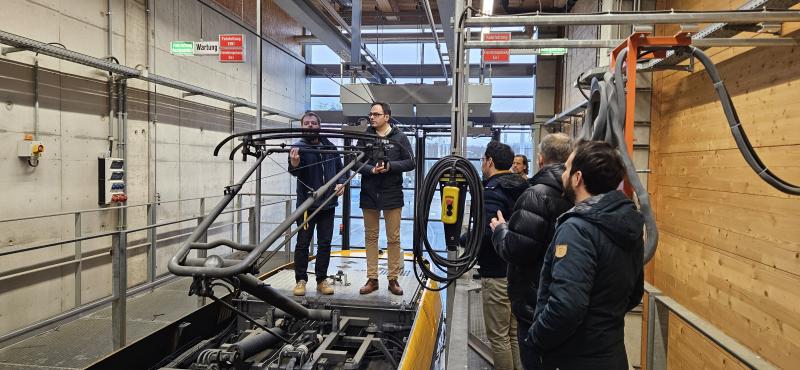
Photo: LVB
A central achievement of the project was the development of a set of circular economy strategies and action plans. The strategies focused on three major areas: energy, infrastructure, and rolling stock. They were based on the Circularity Compass and the AETE framework – Avoid, Extend, Transform and Enable – which provides a structured way of identifying opportunities to reduce resource consumption, waste, and environmental impacts throughout the life cycle of public transport systems. These strategies were subsequently translated into four locally tailored Action Plans for Maribor, Leipzig, Gdynia, and Bergamo. The plans addressed practical issues such as capturing and using waste energy, improving infrastructure maintenance, supporting electrification, and introducing circular procurement for vehicles.
CE4CE also developed several practical solutions based on real-world pilot projects. These included predictive maintenance systems for infrastructure and rolling stock in Leipzig and Bergamo, using sensors and data to identify potential problems before they lead to major failures.
Another solution focused on business planning for electrified public transport fleets and infrastructure in Gdynia, using digital twin modelling and energy flow simulations to evaluate investment and energy-management scenarios. In Szeged, the project demonstrated that trolleybus switches removed from the main network could be reused in a depot – where they are used less intensively –, providing guidance for other operators interested in extending the lifetime of infrastructure components. The goal of the second pilot project in Szeged was to develop and implement a universal electric door control unit that is compatible with the original Tatra controllers, meets modern safety and regulatory requirements, and provides advanced diagnostics. During the pilot project, 40 units were manufactured, and extensive testing is currently underway in a real-world environment with software modifications. The solution can later be applied to trolleybuses using a similar door system.
In Maribor, second-life batteries were used to store renewable energy for fast-charging infrastructure, demonstrating how batteries from their first application can continue to provide value. The project also explored the remanufacturing of obsolete door control electronics for Tatra trams, demonstrating how reverse-engineering and redesign can support the continued use and maintenance of legacy tram components.
Maribor: second-life batteries

Photo: Municipality of Maribor
An important part of CE4CE was also knowledge sharing and capacity building. The project created an online e-course covering circular economy principles, lessons from the pilot projects, practical solutions, and measures that could be replicated elsewhere. The project was presented at numerous European events and conferences, including the Transport Research Arena (TRA), where it received the TRA 2026 Host Award. Other engagement activities included hackathons with university students and policy workshops bringing together stakeholders to discuss barriers to circular public transport.
The project placed strong emphasis on cooperation beyond its own partnership. CE4CE worked with other European projects and organisations, including the Advisory Board members of the project (ICLEI European Secretariat, UITP, EIT Urban Mobility), and several Interreg and Horizon Europe projects. These partnerships helped validate the project’s tools, disseminate its results, and connect CE4CE with a wider community working on sustainable and circular urban mobility.
Presentation about the pilot in Leipzig
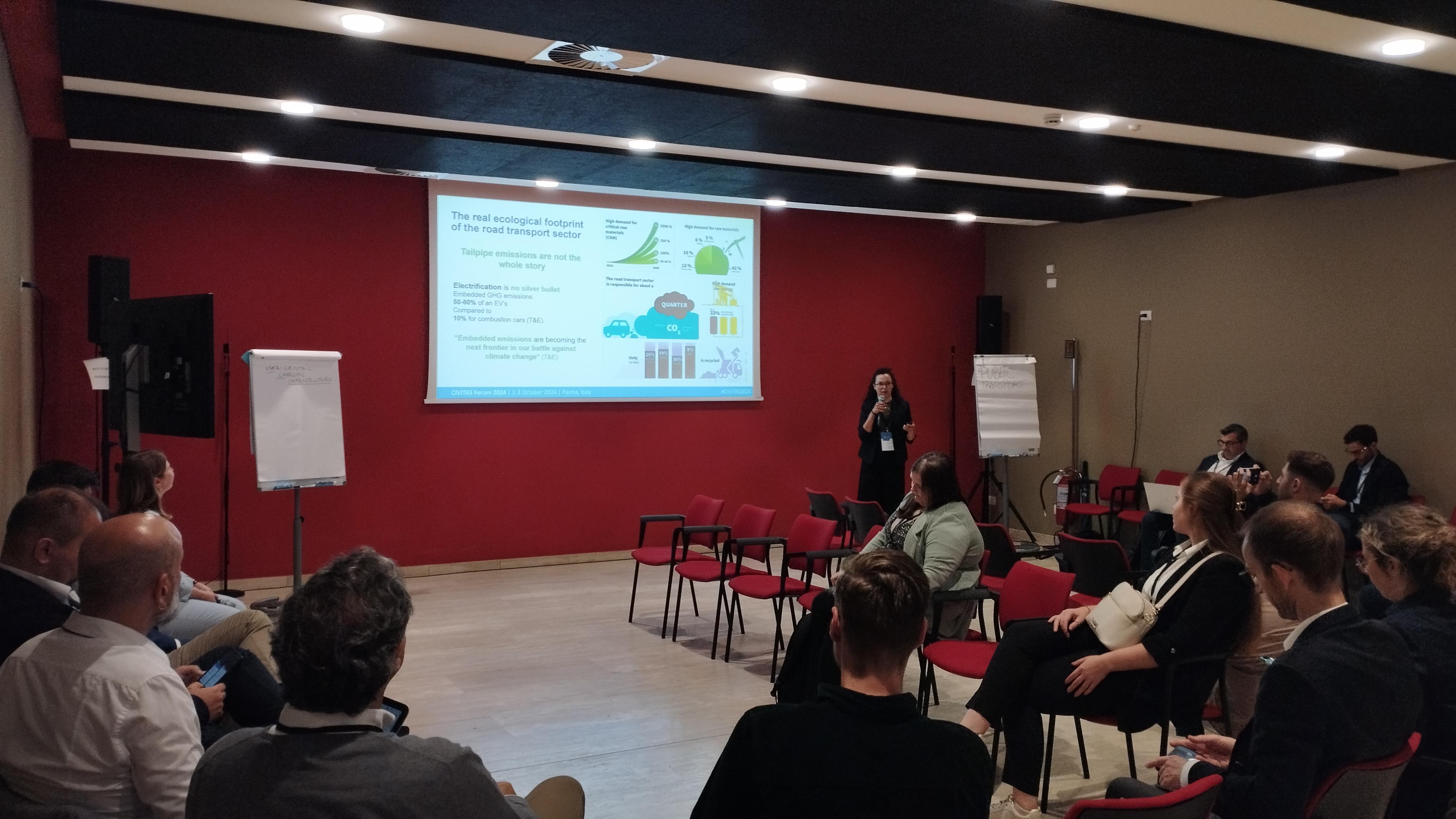
Photo: Antal Gertheis/Mobilissimus
Although the CE4CE project itself has ended, its results are expected to have a long-term impact. The CE4CE Knowledge Platform will continue to operate after the project's completion and will be managed by trolley:motion association. The platform will remain a hub for tools, best practices, knowledge resources, and connections between organisations interested in circular public transport. The project has also produced guidelines and a handbook explaining how its strategies, action plans, pilots, and solutions can be applied in other cities and public transport systems. All tools are available on the website.
Overall, CE4CE has helped turn the concept of circular economy in public transport into practical and transferable approaches. Through strategies, local action plans, pilot projects, digital tools, training, and stakeholder cooperation, it demonstrated ways to extend the lifetime of vehicles and infrastructure, reuse materials and components, optimise energy use, and reduce waste. Its main legacy is therefore not only the individual tools and solutions developed during the project, but also the knowledge, partnerships, and framework that can support public transport organisations across Europe in continuing the transition towards a more circular and sustainable sector.
Coverphoto: ATB