Updated Project Description (2021–2026)
Project Background & Overview
The preparation of the Budapest Agglomeration Cycling Network Development Strategy ("Cycling Garden Suburbs") commenced in July 2021 under Government Resolutions 1652/2020 (X. 9.) and 1377/2020 (VII. 10.). Commissioned by the former Budapest Development Centre (BFK), the project was carried out by the Mobilissimus Kft. – Értékterv Kft. consortium in cooperation with the Hungarian Cyclists' Club and specialized sub-contractors.
The planning process reached the implementation planning phase (approx. 88.7% completion) by spring 2022 when the Government issued Resolution 1281/2022 (VI. 4.), ordering the suspension of non-under-construction state design projects as of July 1, 2022. The original contract was formally closed at the end of 2023, and project responsibility was transferred to the new ministry in October 2025.
The strategy and main network plan were reviewed, updated, and finalized between January and April 2026 under a new contract commissioned by the State Secretariat for Active Hungary of the Ministry of Public Administration and Regional Development (KTM).
The primary objective of the strategy is to increase daily utility cycling and combined trips (cycling + rail/public transport, B+R) across the Budapest agglomeration. Between neighbouring suburban towns and the capital, cycling offers a realistic commuting alternative; thus, the strategy defines a connected regional main network seamlessly linked to Budapest's urban cycling network. Aligned with the Budapest Agglomeration Rail Strategy (BAVS), special emphasis is placed on improving cycling accessibility to suburban railway stations and expanding B+R parking facilities. Infrastructure measures are accompanied by a comprehensive attitude-change and communication framework prepared in close cooperation with the Hungarian Cyclists' Club.
Study Area
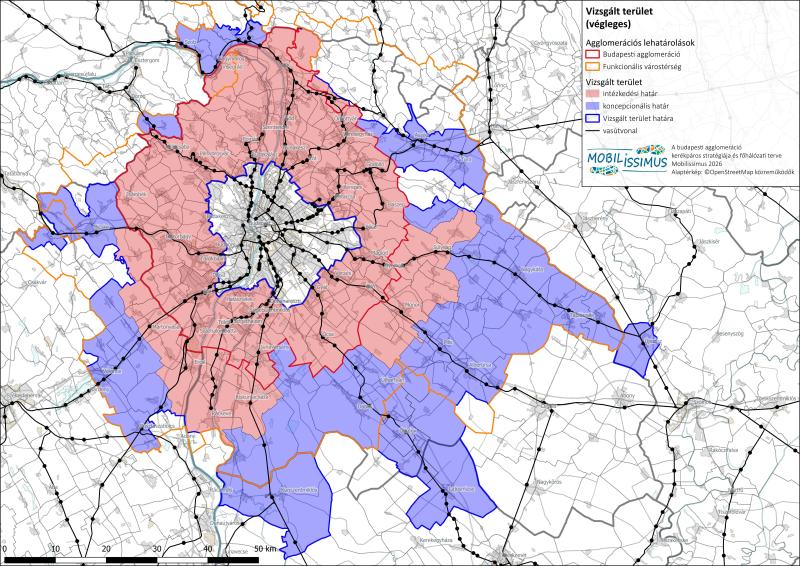
The study area was delineated based on the Functional Urban Area (FUA) defined by the Hungarian Central Statistical Office (KSH), commuting flows, and rail transit connections:
- Conceptual Boundary: The broader perimeter covering the status analysis and conceptual planning.
- Action Boundary: The inner suburban perimeter where network projects were defined, prioritized, and compiled into the action plan. Based on municipal consultations during the planning process, the action boundary was expanded to include municipalities such as Ecser, Pilisjászfalu, Kosd, Kóka, Úri, Gomba, Csévharaszt, Ráckeresztúr, Ercsi, Gyúró, Tordas, and Etyek.
Planning Process & Timeline (2021–2026)
The strategy followed a consistent strategic logic across distinct phases:
- 1. Status Analysis Phase (2021): Processing demographic, mobility, and network data; conducting 8 focus group studies, 11 key stakeholder interviews, public Maptionnaire mapping surveys, and formulating the SWOT analysis and problem map.
- 2. Concept Formulation Phase (2021–2022): Formulating the vision and target hierarchy (2 strategic and 6 operational objectives), establishing the main network and feeder concepts, and identifying cycle expressway corridors. Consultations with the Municipal Association of the Budapest Agglomeration (FAÖT) and professional workshops.
- 3. Implementation Planning, Suspension & Reorganization (2022–2025): Clustering network sections into discrete projects and prioritizing them until the government suspension in July 2022. Closing former contracts (2023) and transferring management to the new ministry (Oct 2025).
- 4. Updating & Finalization (Jan–Apr 2026): Data updating (KSH 2025 figures, MÁV B+R data, municipal projects), a new written municipal review round on micro-regional summaries (Feb 25 – Mar 5, 2026), finalizing the investment program, and completing the documentation (April 2 / April 27, 2026). A Strategic Environmental Assessment (SEA) was carried out in parallel.
Key Deliverables & Results
- 288 Network Projects: Defined within the action boundary, including 46 Budapest–suburban center links, 173 inter-municipal links, and 69 public transport feeder projects.
- 49 Action Sheets: Detailed project sheets for non-infrastructural and horizontal measures (e.g., Highway Code revision for cyclists, strengthening the Cycle Design Jury, B+R development program, bicycle officer network, workplace mobility plans, awareness raising).
- Action Plan & Investment Program (up to 2030): Aligned with the 2021–2027 EU funding period (extended to 2030 under the n+3 rule), featuring a prioritized project list with an initial estimated budget of HUF 17.75 billion.
- Awareness-raising Handbook: Prepared by the Hungarian Cyclists' Club (Agglomeration Cycling Strategy – Awareness-raising Handbook).
Client (2026)
Ministry of Public Administration and Regional Development (KTM), State Secretariat for an Active Hungary; and, following legal succession beginning in the summer of 2026, the Ministry of Transportation and Investment (KBM)
Consortium (2026):
Mobilissimus Kft.
Subcontractors (2026):
Client (2021-2023):
Consortium (2021-2023):
- Mobilissimus Kft. (consortium lead)
- Értékterv Kft.
Subcontractors:
- MEGÉRTI Kft.
- LANDSCOPE Kft.
- Trans-Sport Consulting Bt.
- Város és Mobilitás Intézet NKft.
- Vasvári Gergely E.V.

